Updated September 29, 2026: the cross-feed results now include controls, and the wire-format comparison can be reproduced from the repo.
A fingerprint has to fit somewhere. In a column beside every record, in an index that has to stay fast, in a payload two systems exchange all day. So the first question is not how clever the fingerprint is. It is how many bytes you are willing to spend on one, and what each size actually buys.
I built one of these. promptlsh turns an adversarial prompt into a short similarity digest — a fingerprint built so that near-identical inputs produce near-identical output, which is the opposite of how a normal hash behaves. ssdeep and TLSH have done this for malware files since 2006 and 2013 respectively. I built a version for prompts, on top of existing pieces (see Credits).
Then I measured what each size on that curve actually buys, and the answer is sharper than I expected. Take an ordinary sentence embedding, round each number down to 8 bits, and 384 bytes retains the full retrieval ceiling — so if you can afford a few hundred bytes per prompt, that is the default and no hashing is required. Shrink to 32 bytes and you give up 11 to 21 points of recall, which buys a twelvefold reduction in storage and index cost, a derived value that is far harder to reconstruct than a quantised vector, and robustness to an evasion that destroys the lexical alternative outright. This is that measurement, and the three cases where 32 bytes is the right call.
There is more than one way to fingerprint a prompt
The fix is obvious. The design question is not. What form should the fingerprint take? There are four plausible answers and they are not equally good.
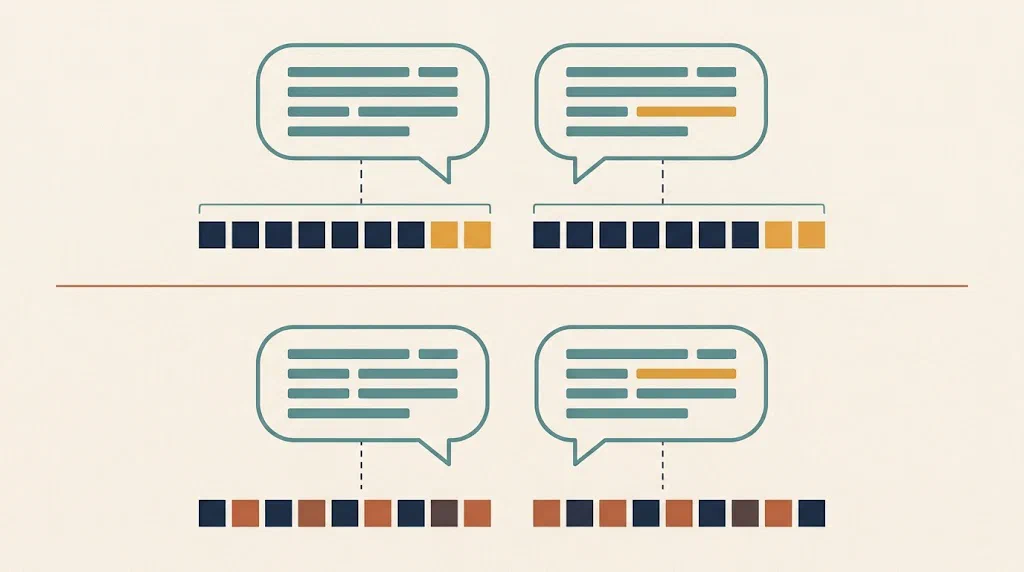
Three of the four are formats this library emits, so they are worth naming once:
plm1— 128-permutation lexical MinHash over word shingles. No embedding model. ~1.1 KB on the wire.pls1— 256-bit SimHash over a sentence embedding. 32 bytes.pls1c— the same, mean-centered against a shared reference. Also 32 bytes, and only comparable to digests built from the same model and the same reference mean.
And the vocabulary, once, so the rest reads without footnotes:
- shingles — overlapping runs of consecutive words. “the cat sat” and “cat sat down” are two three-word shingles of the same sentence.
- MinHash — a way to estimate how much two sets overlap without comparing them directly. Here the sets are shingles, so it measures shared wording.
- SimHash — the same trick for vectors rather than sets. It slices the space with random planes and records which side of each plane a vector falls on, so similar vectors get similar bit patterns.
- embedding — a model’s numeric representation of a piece of text, typically a few hundred numbers. Similar meanings land near each other.
- quantising to int8 — rounding each of those numbers to a whole number between −127 and 127, so each takes one byte instead of four.
- recall@1 — the headline score below. Given one prompt and a pile of candidates, does its true match come back as the single closest result? Recall@1 of 0.767 means that happened 76.7% of the time.
- candidate pool — the size of that pile. A bigger pool is harder, because there is more to be wrong about.
- the ceiling — what the full, unshrunk embedding scores on the same task. It is the best any smaller version of it could hope to match.
The corpus is more redundant than you’d guess
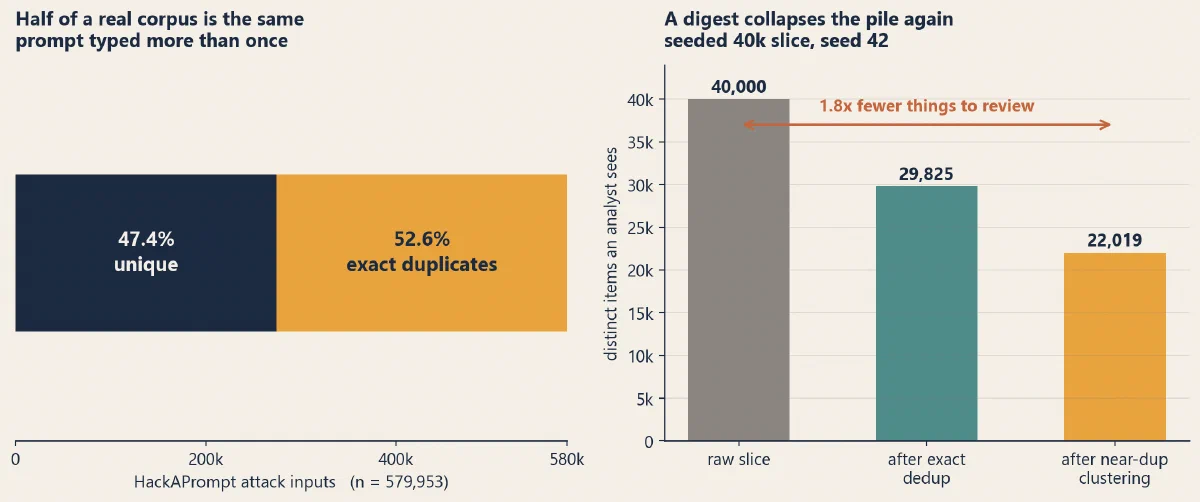
The problem is real and measurable. On the full HackAPrompt attack set — 579,953 inputs — 52.6% are exact duplicates after normalisation, leaving 274,804 unique. The rate holds across models (36% to 52%) and climbs by challenge level (31% to 100%).
HackAPrompt is multilingual, and a tokeniser that stripped non-Latin text would collapse those prompts together and inflate the duplicate rate. These figures use a Unicode-aware tokeniser, so the redundancy is real rather than an artifact of tokenisation.
Beyond exact duplicates, near-duplicates matter more. On a seeded 40k slice, 25% are exact duplicates and roughly another 35% of the unique prompts pull into near-duplicate clusters — an overall ~1.8x collapse. Deduplicating by digest genuinely cuts what an analyst reviews. (HackAPrompt is a competition corpus, so its redundancy sits on the high side; treat the shape, not the exact factor, as the takeaway.)
What I actually measured
Deduplication works. The engineering choice is what goes on the wire, and the options form a size/fidelity curve:
- a full float embedding — the ceiling, roughly 1.5 KB per prompt;
- an int8-quantised embedding — roughly 384 bytes;
- a 256-bit SimHash digest — 32 bytes (this is what
promptlshemits aspls1/pls1c); - a dependency-free lexical MinHash (
plm1) — no embedding model at all.
The task: recall@1 on WildJailbreak paraphrase pairs. Each vanilla request (about 113 characters) has a jailbroken rewrite (about 979 characters) — same intent, very different surface. For each vanilla request, is its true rewrite the top match among N candidates? I ran it on a general model (bge-small, the clean reference) and a domain-tuned one (0din).
The result that argues against my own tool
The int8-quantised embedding keeps essentially the entire ceiling: 0.767 against a 0.767 ceiling on the general model, 0.820 against 0.820 on the domain-tuned one, both at a 400-candidate pool, all for about 384 bytes. The 256-bit SimHash digest gives up 11 to 21 points against that ceiling; the best case, domain-tuned and centered, is 0.708 against 0.820. That gap is the price of shrinking 384 bytes down to 32.
The dependency-free lexical digest fares worse still. At 128 permutations a plm1 digest runs about 1.1 KB — three times larger than the int8 embedding — and scores 0.537, well below it. Beaten on both axes at once, it is not a point on the size/fidelity curve. It sits off it.
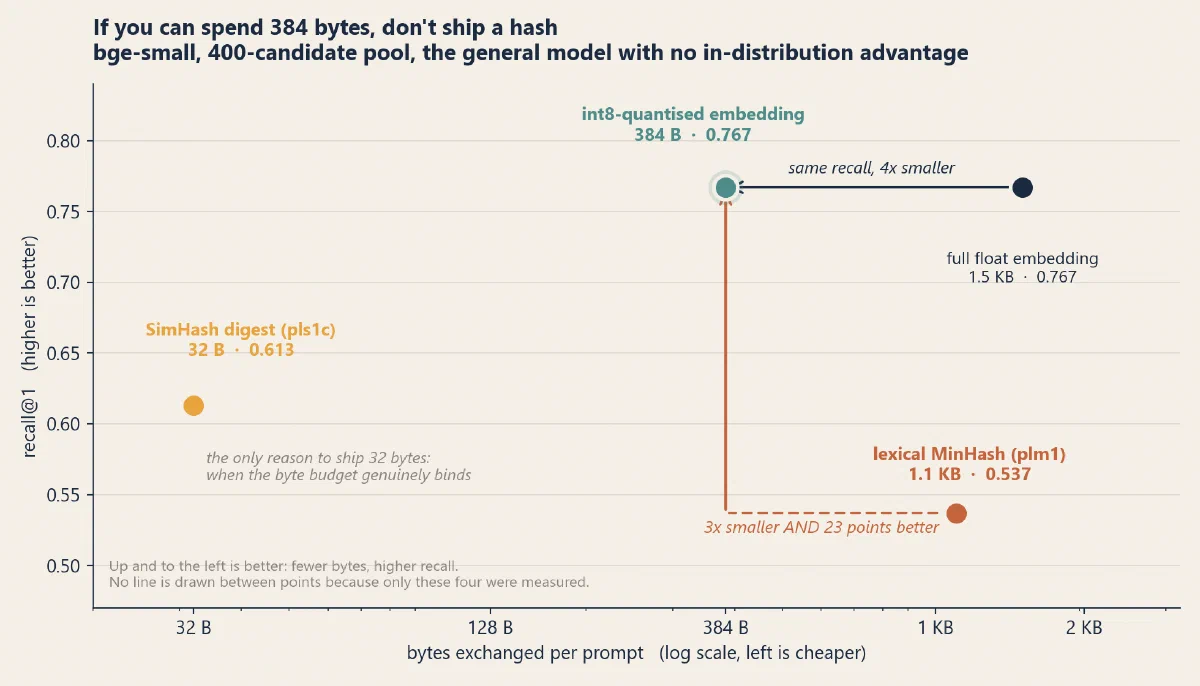
The blunt version: if you can exchange a few hundred bytes per prompt, ship the int8-quantised embedding, not a hash. That is what the numbers say, and there is no point pretending otherwise.
This needs no code from promptlsh: take the embedding you already have, divide each vector by its own max absolute value over 127, round to int8, and keep the scale factor alongside it. That is symmetric per-vector quantisation in three lines of numpy, and it is what eval/wire_formats.py measures.
What the hashing buys anyway
So why does the 32-byte digest exist at all? The measurement narrows it to three honest cases.
First, where the byte budget genuinely binds. Thirty-two bytes against 384 is about a twelvefold difference in storage and index size. Attach a fingerprint to every observable across a high-volume feed and that multiple stops being academic.
Second, where you would rather not put something near-invertible on the wire. A SimHash of an embedding is lossy in a way a quantised embedding is not — the quantised vector is close to recoverable, the bit-signature much less so. That is a difference in degree of exposure, not a privacy guarantee, and I would not dress it up as one.
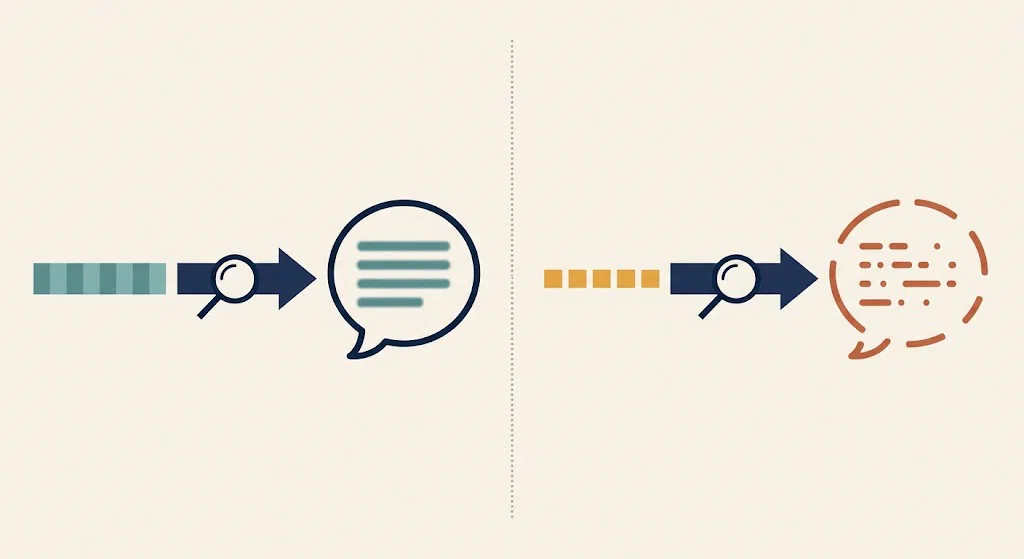
Third, where the evasion you face is reordering. Shuffling the words of a prompt keeps its meaning and destroys every word shingle, which makes it the cheapest possible attack on a lexical digest. It works completely: shuffle the words and plm1 similarity falls to 0.001, indistinguishable from two unrelated prompts. The semantic digest barely notices. On the same 300 prompts, pls1 keeps 84.3% of its bits identical — the same closeness as a cosine of 0.881, against 0.885 for the full unshrunk embedding. Almost none of the signal is lost.
The 32-byte digest is more than a degraded embedding. Against a one-line evasion that reduces the lexical digest to noise, it is categorically more durable. That is a third reason to ship it, and a harder one to argue with than the byte budget.
Putting the options side by side
| Format | Bytes | recall@1 | Survives word reorder? | Needs a model? |
|---|---|---|---|---|
| full float embedding | ~1,536 | 0.767 | yes (0.885 cosine) | yes |
| int8-quantised embedding | 384 | 0.767 | yes | yes |
pls1c SimHash digest | 32 | 0.613 | yes (0.881 implied) | yes |
plm1 lexical MinHash | ~1,160 | 0.537 | no (0.001) | no |
All figures bge-small at a 400-candidate pool, from eval/wire_formats.py. The reorder
column is mean similarity between a prompt and its own word-shuffled copy.
I have deliberately left out a column for invertibility. It matters — it is the second case above — but I have not measured it, and turning “a bit-signature leaks less than a quantised vector” into a tidy High/Medium/Low rating would be inventing precision I do not have. That is the same mistake as the cross-org figure below, and once is enough.
The table only covers the wire, and lookup is a separate axis. These formats do not index the same way. Quantised and full vectors want approximate nearest-neighbour search — HNSW, IVF, the usual vector-database machinery. A 256-bit signature is instead a Hamming-distance problem: XOR and popcount, which is a single instruction on modern hardware, and which multi-index hashing partitions cheaply. I have not benchmarked the two at scale, so I will not claim a latency winner. But if your deployment constraint is index cost rather than wire cost, that is a second axis the recall numbers above say nothing about.
The lexical plm1 has exactly one reason to exist, and it is neither size nor accuracy:
zero ML dependency. No model to download, pin, or run; fully deterministic and offline.
Use it when you cannot run an embedding model at all. Otherwise the embedding path wins.
Two smaller findings worth carrying. Mean-centering (pls1c) — subtracting the average of a shared reference set before hashing, so that what every prompt has in common stops crowding out what makes each one distinct — buys the digest about 5 to 6 points and is essentially free. And a domain-tuned model beats a general one at both the ceiling and the digest. But a general model already gives a usable result — around 0.61 recall@1 at a 400-candidate pool — so no fine-tuning is required to get value.
The hard part: correlating across feeds barely works
Everything above measures one corpus against itself. The reason to attach a fingerprint to a shared observable is different: so two organisations can discover they are looking at the same attack. That is a harder measurement, and it is easy to get a flattering number by accident.
Split one corpus in half, call the halves two organisations, and the digest finds about 2.9x the overlap that exact matching does — 35.1% against 12.2%. That number is real, but both halves came from the same competition and shared wording by construction, so what it measures is the exact-versus-fuzzy gap on closely related material. It says nothing about two organisations that collected independently.
The test worth running uses corpora that never touched each other: five independently collected public sources, treated as five organisations, with positive controls and a null baseline to separate “found nothing” from “measured it wrong.” The picture is a good deal thinner.
On literal text, cross-feed correlation is essentially zero. Independent feeds do not share wording, so a wording-based fingerprint has nothing to grip. Across every pair of feeds, in both directions, the highest match rate was 0.07%.
Semantically it is real but conditional. Two independently assembled collections of human jailbreaks overlapped by 10 to 21 percent — genuinely useful, and a floor rather than a ceiling, because the threshold I used is stricter than a typical true pair. But feeds that collect different kinds of artifact — jailbreak wrappers versus bare harmful requests — barely correlate at all regardless of who gathered them. And the two largest overlaps, at 25 to 39 percent, turned out to be between datasets built from one another. Those measure my pipeline working, not the world agreeing.
A digest reliably collapses redundancy inside a feed, which is
the 1.8x result earlier. Treat cross-organisation correlation as opportunistic, and expect it
only between feeds that collect the same kind of thing. Full tables in
RESULTS.md §2b.
What this doesn’t show
- These are matching rates on one dataset’s paraphrase pairs, not a detection benchmark. The digest answers “are these the same attack reworded,” not “is this an attack.”
- The strongest model (
0din) is in-distribution: its model card reports pre-training on 161,396 WildJailbreak pairs, which is the evaluation set itself.bge-small, a general model without that exposure, is the honest reference, and it supplies every headline number here. - Recall@1 degrades as the candidate pool grows — the centered digest drops from 0.613 at 400 candidates to 0.534 at 1000 on the general model, as expected for nearest-neighbour retrieval.
- I have not measured invertibility, only argued about it. The claim that a bit-signature exposes less than a quantised vector is structural reasoning, not a result.
- The candidate pools are small. Everything here runs at 400 and 1,000 candidates, and recall already falls from 0.613 to 0.534 across that gap. A production feed indexes hundreds of thousands of observables, and nothing in this evaluation tells you where the curve lands there. I would expect it to keep falling. If you are sizing this for real, measure it at your own scale before trusting any number above.
- Reordering is one evasion, not the category. The robustness result tests word-shuffling, which is the cheapest attack available. Synonym substitution, inserted noise, and structural rewrites are all untested here, and there is no reason to assume the digest holds up equally against them.
So what should you actually ship?
The whole measurement collapses into three cases.
- You can spend a few hundred bytes per prompt. Ship the int8-quantised embedding. It keeps the full retrieval ceiling — 0.767 against 0.767 — at a quarter the size of the float vector. This is the default, and it is not this library.
- You are pinned to a tiny wire budget, or you would rather not transmit something close
to invertible. Ship
pls1c, the mean-centered 256-bit digest. You pay about 15 points of recall for a twelvefold size reduction, and you get reorder robustness that the lexical digest cannot offer. - You cannot run an embedding model at all — air-gapped, edge, or a pipeline that must
stay deterministic with no ML dependency. Use
plm1, and know what you are accepting: it is both larger and less accurate than the int8 embedding, and a single word-shuffle reduces it to noise.
If none of those describe you, you probably do not need a fingerprint yet.
Reproduce it
Every number above except the cross-feed overlaps comes from eval/ in the promptlsh
repo, with the full tables in
RESULTS.md:
eval/wire_formats.py— the recall@1 comparison across all five wire formats, and the reorder-robustness test. Fixed seeds, so it reproduces exactly.eval/cluster_corpus.py— the corpus redundancy figures.- The cross-feed overlap numbers come from a script that is not published, because three of the five feeds are gated datasets that each need terms accepted individually. Those figures are not reproducible from the repo.
Everything runs on public corpora — HackAPrompt, JailbreakBench, HarmBench, WildJailbreak — and no corpus is committed to the repo. WildJailbreak is gated, so you will need to accept its terms on HuggingFace before the paraphrase-pair evaluation will run.
Credits
The techniques here are other people’s. The evaluation and the packaging are mine.
Prior art. Similarity hashing for correlation is long-established in malware analysis —
ssdeep (Kornblum, 2006),
TLSH (Oliver et al., 2013), and sdhash. The underlying maths is older:
Broder’s MinHash for Jaccard over shingle sets, and Charikar’s SimHash for
random-hyperplane LSH. Applying it to prompts is not new either —
0DIN’s prompt-toolkit
emits 256-bit SimHash signatures for prompts in a versioned, model-pinned format, and
independently arrived at the same model-identity safeguard this library uses. If you want
the closest existing work, start there.
The domain model. 0dinai/jailbreak-embeddings-base-onnx,
a multilingual-e5-base fine-tune published by 0DIN (Mozilla). Note its training data
overlaps this evaluation set, which is why bge-small supplies the headline numbers.
Datasets. HackAPrompt (Schulhoff et al., EMNLP 2023) · WildJailbreak / WildTeaming (AI2) · HarmBench (Mazeika et al.) · JailbreakBench (Chao et al.) · AdvBench (Zou et al.) · the in-the-wild jailbreak corpus of Shen et al..
Tooling. fastembed (Qdrant),
onnxruntime, and the
BAAI/bge-small-en-v1.5 embedding model.
Code. promptlsh and
adversarial-ai-cti, both Apache-2.0.